Elden Ring Nightreign: Redefining Co-op Exploration in FromSoftware's Universe
Elden Ring Nightreign delivers a bold, cooperative twist on exploration, setting new expectations for fans of the acclaimed series.
The gaming community's anticipation for Elden Ring Nightreign continues to build as we approach its release. While FromSoftware's track record suggests another masterpiece in the making, players should calibrate their expectations for this spin-off, which promises to deliver a fundamentally different experience from its predecessor. Understanding these distinctions will be crucial for players to fully appreciate what Nightreign aims to accomplish rather than measuring it against the original Elden Ring's standards.
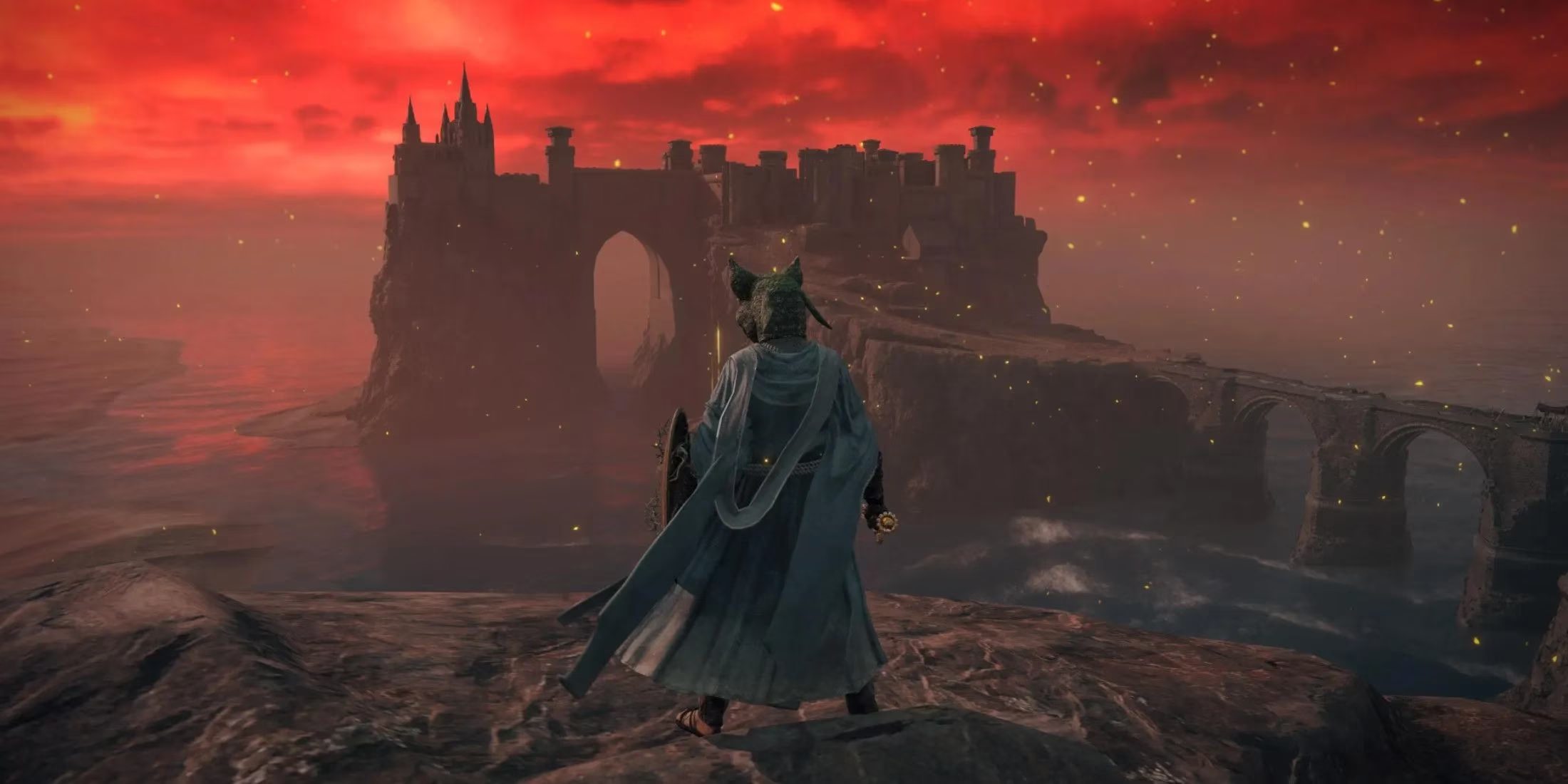
The Heart of Elden Ring's Success
What truly elevated Elden Ring to its legendary status wasn't just its combat mechanics, intricate lore, or stunning visuals—though these elements certainly contributed. The game's soul resided in its approach to exploration. The Lands Between created an environment where discovery felt genuinely organic and player-driven. The deliberate absence of conventional open-world elements like map markers, objective lists, and guiding NPCs might seem unintuitive initially, but this design choice transformed exploration from a checklist-ticking exercise into an authentic adventure.
This exploration-centered design gave players unprecedented freedom. Spotting an intriguing landmark in the distance could spark an hour-long journey with no artificial constraints—no time limits, no map-restricting fog, and no companions with competing priorities. This pure freedom to wander and discover became Elden Ring's defining characteristic.
Nightreign's Cooperative Constraints
Elden Ring Nightreign appears poised to introduce a fundamentally different approach through its cooperative gameplay focus. While official details remain limited regarding player movement restrictions, it's reasonable to expect some form of proximity requirements to prevent players from scattering across the map. Even without explicit boundaries, the game's mechanics will likely encourage players to stay together—enemy difficulty scaling based on player count means solo exploration during co-op sessions could become prohibitively challenging.
These cooperative elements will inevitably transform the exploration experience. The spontaneous, hours-long journeys to distant landmarks that characterized the original game will now be filtered through:
-
Group consensus on destinations
-
Potential proximity limitations
-
Scaled enemy difficulty
-
Coordinated combat requirements
The result will be an experience that, while set in the same universe, functions on fundamentally different principles.
Rethinking "Freedom" in Game Design
🎮 Gaming discussions often equate freedom with quality—more options must mean a better experience, right? This perspective overlooks how thoughtful restrictions can enhance gameplay rather than diminish it.
Consider FromSoftware's own catalog:
| Game | Design Approach | Fan Reception |
|---|---|---|
| Bloodborne | Linear, focused | Beloved classic |
| Sekiro | Structured progression | Critically acclaimed |
| Elden Ring | Open-world freedom | Revolutionary hit |
Each title succeeds through different balances of freedom and constraint. Bloodborne and Sekiro demonstrate how more restrictive frameworks can deliver equally compelling experiences by:
-
Forcing players to adapt their strategies
-
Creating more finely-tuned combat encounters
-
Delivering more focused narrative moments
-
Crafting memorable, handcrafted scenarios
Embracing Nightreign's Identity
Nightreign's more structured approach doesn't represent a step backward but rather a deliberate design choice that will shape its unique identity. The cooperative framework will likely create experiences impossible in the solitary journeys of the original game:
-
Coordinated tactics against powerful enemies
-
Shared moments of discovery
-
Collaborative puzzle-solving
-
Dynamic interactions between different character builds
The key for players approaching Nightreign will be understanding its intentions rather than measuring it against Elden Ring's exploration-focused design. A more restrictive framework isn't inherently negative—it's simply the foundation for a different type of experience.
Looking Forward
As 2025 progresses and we draw closer to experiencing Elden Ring Nightreign firsthand, the community would be well-served to approach it as its own entity rather than a direct extension of the original game. FromSoftware has consistently demonstrated an understanding of how different design philosophies serve different experiences.
The studio's history suggests Nightreign will excel within its cooperative framework while still delivering the challenging combat, atmospheric worldbuilding, and cryptic storytelling that have become FromSoftware hallmarks. The question isn't whether Nightreign will match Elden Ring's approach to exploration, but rather what new experiences its cooperative focus will unlock.
For those whose love of Elden Ring centered primarily on solitary exploration, Nightreign might initially feel constraining. However, for players open to a new interpretation of the world—one built around shared discovery and coordinated challenges—Nightreign could offer something equally compelling but distinctly different from its predecessor.
The true measure of Nightreign's success won't be how closely it mimics the original game's freedom, but how effectively it crafts meaningful experiences within its cooperative framework. As with all FromSoftware titles, the journey will undoubtedly be challenging—but those who embrace its unique identity rather than measuring it against past experiences may find something just as revolutionary in its own right.