Elden Ring's 'Hospitality' Secrets: How FromSoftware Crafted a World That Devours Souls in 2026
Elden Ring's world design, termed 'hospitality' by FromSoftware, uses color and landmark seduction to drive exploration.
In the annals of video game history, few titles have imprinted themselves upon the collective psyche with the searing intensity of Elden Ring. Even in 2026, its shadow looms as vast as the Erdtree itself, a golden beacon of inscrutable design philosophy. The Lands Between are not merely a playground; they are a meticulously orchestrated symphony of dread, wonder, and an almost parental care that its creators, in a moment of bewildering humility, labeled "hospitality." At the 2022 Computer Entertainment Developers Conference in Kyushu, 3D graphic artist Atsushi Miyauchi and visual artist/motion designer Teppei Morita peeled back the cosmic veil, revealing design techniques so diabolically thoughtful they bordered on sorcery. Their lecture exposed the raw, beating heart of FromSoftware's genius: a world crafted not to punish the player, but to seduce them into an endless waltz of discovery and annihilation.
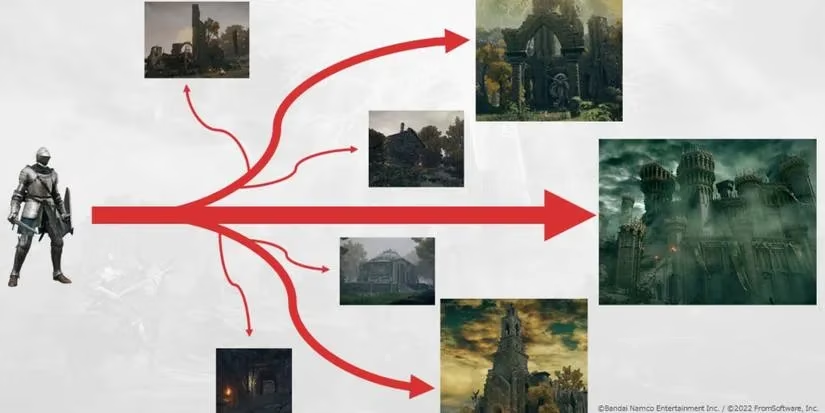
The developers spoke of "hospitality" with the reverence of a Michelin-starred chef preparing a dish laced with ghost peppers. This is no gentle hand-holding; it is a ruthless kindness. The term encapsulates how they inject characterization into the very marrow of their world, ensuring players not only "find things" but have those moments seared into memory with the ferocity of a dragon's breath. To achieve this, they dissected the game world into three escalating tiers of manipulation—sorry, guidance—a trinity of environmental seduction: Large (Area Concept and Color), Medium (Landscape Variation), and Small (Boredom Reduction Elements). This tripartite framework is the invisible script that turns a casual wanderer into a raving cartographer, scrawling mental maps by firelight.
The Three Pillars of Worldly Temptation
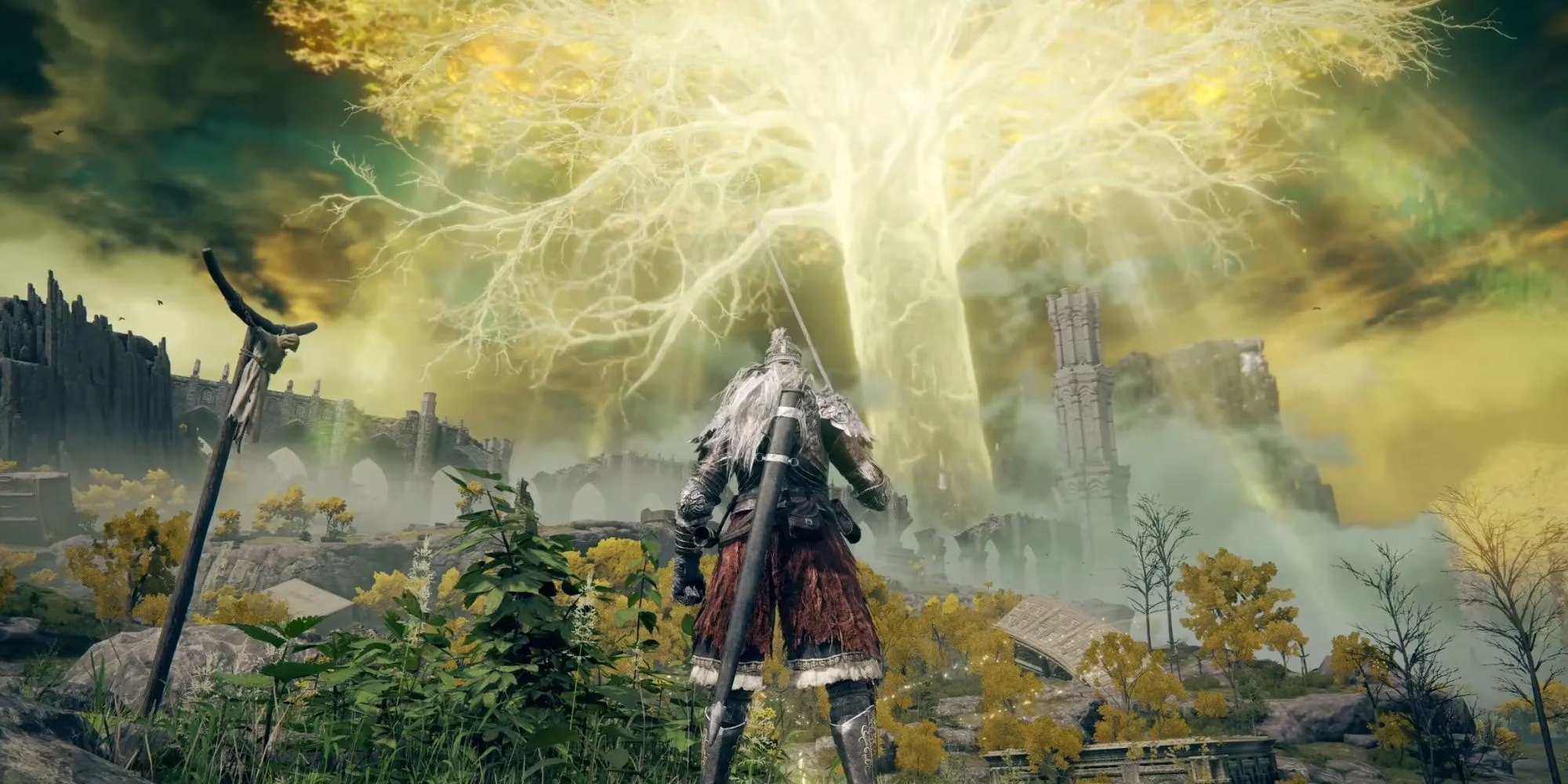
At the highest, most majestic level, the team conjures a grand area concept and an associated color palette that acts as an emotional anchor. Imagine Liurnia of the Lakes: that pervading, aqueous blue-grey mist that whispers of ancient sorrow and drowned secrets, or the pustulent crimson rot of Caelid that screams of a divine biological apocalypse. This is not mere background art; it is a chromatic sedative or stimulant injected directly into the player's limbic system. FromSoftware then erects colossal, unmistakable silhouettes—the Erdtree, the divine towers, the shattered Elden Ring itself—acting as celestial lighthouses that spark a feral curiosity even from a continent away. The player is not looking at a graphical asset; they are being psychically tethered to a landmark, compelled by an urge that bypasses rational thought.
Below this macro-level wizardry lies the realm of Landscape Variation. This is where the path itself becomes a silver-tongued liar, gently coaxing the player forward. Miyauchi and Morita described the implementation of countless exploration elements and cunning detours. A Tarnished might spot a faintly glowing skull along a cliffside, a shimmering piece of crafting material down a seemingly inconsequential crevasse, or a single, oddly placed statue whose very existence is a question mark. These are not accidents; they are meticulously placed breadcrumbs in a trail that leads not to a witch's oven, but to the medium-sized secret: a hidden catacomb, a wandering merchant, a terrifyingly out-of-depth boss arena. The genius is in the absence of force. There are no obnoxious UI icons screaming "INTERESTING THING OVER HERE!" No pulsating exclamation marks. The landscape itself becomes the quest giver, whispering directly to the soul, orchestrating a rebellion against the modern gaming plague of blinding iconography. The player believes they made the decision to explore that foreboding cave, never realizing they were a moth spiraling toward a brilliantly designed flame.
Finally, there are the Boredom Reduction Elements, the microscopic details that ensure the journey between major discoveries is never a barren commute. It could be the way the wind sculpts the grass in Limgrave, revealing a hidden path for a fraction of a second. It might be a lone, frenzied villager pounding their head against a wall, a snippet of environmental storytelling that fills the void with haunting narrative. These elements keep the brain in a state of constant, low-level engagement, a trance of vigilance. The player is never bored, never aware of the strings being pulled; they are simply there, breathless and fully immersed in a world that feels alive enough to hate them.
Enemies as Operatic Nightmares: The Thematic Scalpel
If the world is a seductive stage, then the enemies are the deranged actors delivering soliloquies of ultra-violence. The FromSoftware approach to enemy design is not to build a moving hitbox, but to birth a psychologically devastating work of performance art. The process begins not with polygons, but with keywords. For General Radahn, the Starscourge, the team conjured concepts like "A sense of grandeur" and a "Character of unparalleled strength," verbalized with terrifying subtlety by his confrontational stand-by pose, his colossal blades planted directly toward the player, a silent declaration of war that needs no health bar to intimidate. Every action, from his gravity-bending cosmic dive to his mournful, maddened roar, spirals outward from this core concept, generating a tension so thick it could be sliced with a Carian Greatsword. Fighting him is not a test of skill; it is a tragic audience with a fallen god, a narrative battle that tells a story of rot and shattered glory with each petrifying frame.
Then there is Godrick the Grafted, an iconic prologue boss who is a grotesque dissertation on inadequacy. The team's keywords were a chilling triptych: "Strange Being With Many Arms," "A King's Dignity," and "A Desire For Power." This thematic skeleton dictates his entire being. His introduction cutscene is a masterclass in thematic foreshadowing: it lingers first on the squirming, superfluous limbs, a visual assault that primes the player for the horror, before finally crawling up to a face contorted by a pathetic, desperate need for validation. Godrick is deciphered as a "Power-Seeker" born entirely from his own crippling weakness. That is the grotesque poetry at play: he gains power not through inner strength, but by dismantling others, grafting their flesh onto his own in a literal, visceral attempt to fill a void that can never be satiated. When he rips off a dragon's head mid-fight and grafts it in a howl of mad genius, it’s not just a phase-two mechanic; it is the ultimate, bloody punctuation of his character thesis. The player is not merely dodging attacks; they are dissecting a psyche.
The Hospitality of Annihilation
The ultimate, brain-shattering revelation from Miyauchi’s lecture is the framing of these efforts as an act of hospitality. In a medium often terrified of frustrating its audience, FromSoftware builds fortresses of overwhelming difficulty and then lovingly, meticulously lines the corridors with wonder. They embed NPC whispers that hold cryptic truths, design map fragments that feel like unearthing forbidden scripture, and engineer entire ecosystems that pulse with a dark, internal logic. Every overturned stone, every horrific creature, every landscape that takes your breath away from altitude is a gift, a token of respect for the player's intelligence and resilience.
This philosophy has proven timeless. In 2026, as the industry drowns in a sea of algorithmically-generated open worlds and safe, familiar sequels, Elden Ring's relentless "hospitality" stands as a towering monument to purposeful design. It buried a longstanding myth that players need constant, aggressive guidance and power fantasies spoon-fed to them. Instead, FromSoftware asked a daring question: what if the greatest respect a game can show is to trust the player to find their own way, to fail, to learn, and to genuinely overcome? The answer, whispered across the Lands Between with a conspiratorial grin, is a guest who will stay forever, happily lost in a hell meticulously designed just for them. ❗️✨