Elden Ring: Why the Two and Three Fingers Split from the One Great
Elden Ring's Greater Will and Frenzied Flame split from the One Great into the Two Fingers and Three Fingers—order versus annihilation.
In the cosmology of Elden Ring, the conflict between order and annihilation runs far deeper than the visible war across the Lands Between. The Greater Will and the Frenzied Flame may seem like irreconcilable Outer Gods, but according to the game's hidden dialogue, they were once part of the same primordial entity known as the One Great. This origin story also explains why their physical messengers in the Lands Between are not a complete hand, but a pair of broken components: the Two Fingers and the Three Fingers. One preaches order, causality, and the continuation of a golden chain. The other seeks to burn everything away so that all existence can converge back into a single whole. Their split is one of Elden Ring's clearest examples of a recurring theme: unity fractured into opposing halves.
The One Great and Hyetta's Revelation
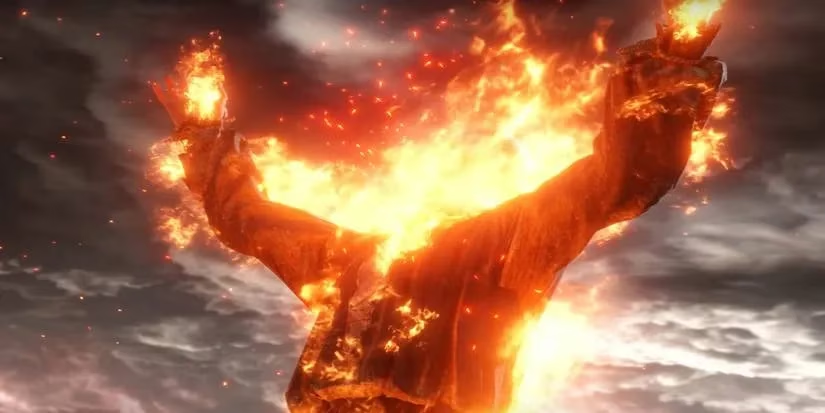
Most of the direct information about the Frenzied Flame's origin comes from Hyetta, a blind Finger Maiden who appears after the Tarnished consumes Shabriri Grapes. Hyetta explains that the Greater Will and the Frenzied Flame were once both part of the One Great, and that this primordial unity later fractured. She also identifies the Greater Will's mistake as the source of all torment, despair, affliction, sin, and curse. In her view, the Frenzied Flame is not simply an agent of chaos for its own sake. Instead, it is a corrective force that believes the only way to repair the original error is to melt the fractured world back into the One Great.
This idea mirrors the game's twin incantations: the Law of Causality and the Law of Regression. Causality is described as the pull between meanings, linking all things in a chain of relation. Regression is the pull of meaning itself, causing all things to yearn eternally to converge. The Greater Will leans toward the first principle, preserving the chain of events even when that chain creates suffering. The Frenzied Flame leans toward the second, desiring a total collapse of distinctions.
The Three Fingers and the Frenzied Flame
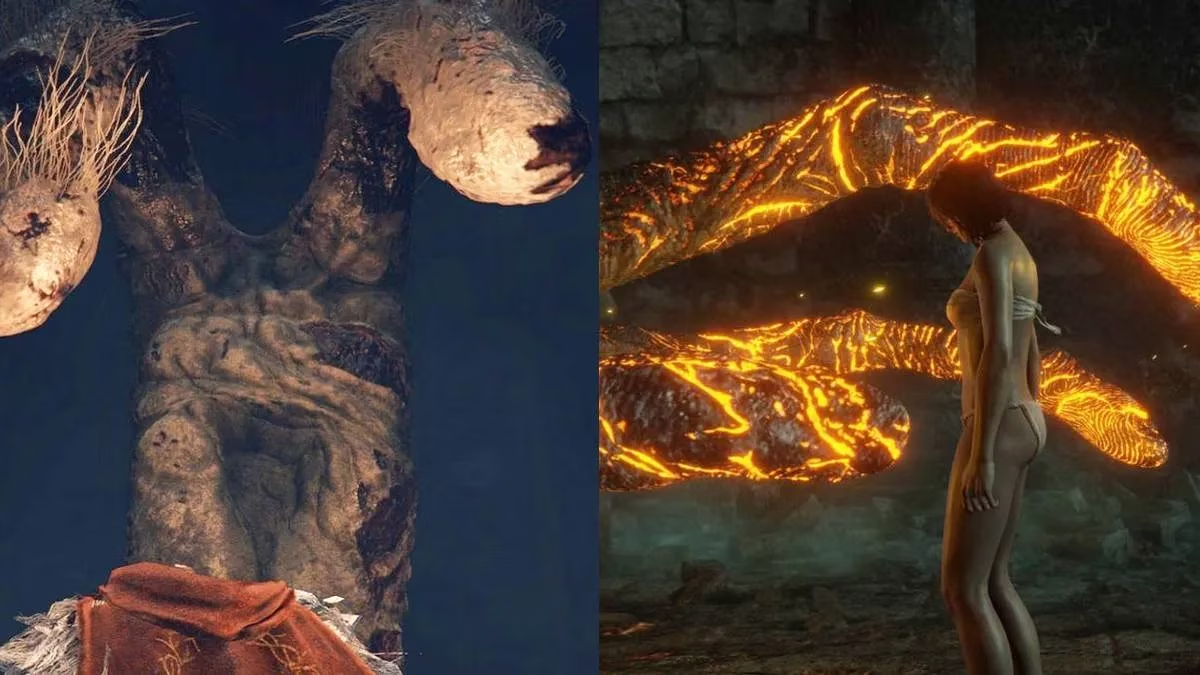
Unlike the Two Fingers, which occupy prominent positions at the tops of Divine Towers, the Three Fingers are hidden deep underground. The hand includes the thumb, index finger, and middle finger, and its surface is traced with veins of light. When the Tarnished approaches, the Three Fingers can seize them and burn fingerprints into their flesh. That moment locks the player into the Lord of Frenzied Flame ending, in which the Lands Between is consumed by yellow flame and the world returns to a state of undivided existence. Unless, of course, the player obtains Miquella's Needle from Malenia and uses it to suppress the flame.
The Three Fingers are deliberately placed away from the ordered surface world. That positioning reinforces the Frenzied Flame's status as an opposing force to the Greater Will. Where the Two Fingers operate through established power structures, the Three Fingers force a direct, painful encounter. The fingerprints they leave are not merely a mark; they are a permanent commitment. Players who meet the Three Fingers face one of the most consequential choices in the game, because the standard route to reverse that choice requires completing a difficult side quest and defeating one of the game's most punishing optional bosses.
The Two Fingers and the Greater Will
In contrast to the Frenzied Flame, the Greater Will follows the logic of causality. Its Two Fingers, representing the ring finger and pinky, sit above the world and act as conduits for the Greater Will's commands. The Greater Will offers more immediate and visible rewards: the power of the Elden Ring, the possibility of godhood, and the guidance of Grace. It even calls the Tarnished back to the Lands Between after Queen Marika stripped them of Grace, trusting that their struggle in exile has made them useful instruments.
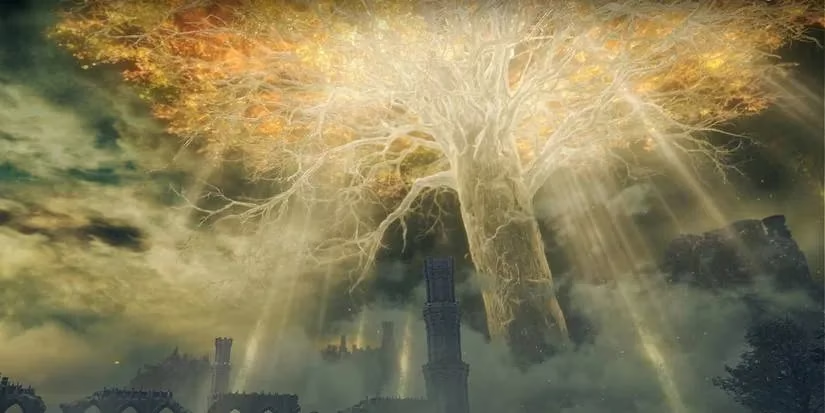
The Greater Will's mistake, as described by Hyetta, remains ambiguous. It might refer to the introduction of Destined Death into the Lands Between, or it could refer to Marika's elevation as vessel of the Elden Ring. Marika believed that suffering built strength, a philosophy that directly conflicts with the Frenzied Flame's desire to end suffering by ending distinction. The game never confirms the exact nature of the mistake. But the conflict it generates is clear: one Outer God wants to continue the chain even if it contains torment, while the other wants to erase the chain entirely.
A Pattern of Divided Hands
The splitting of one hand into the Two Fingers and the Three Fingers is easy to read as symbolic. A complete hand becomes two incomplete parts, and neither can function as the original whole. That visual metaphor reinforces the deeper lore. Just as the One Great fractured into the Greater Will and the Frenzied Flame, their physical messengers also fractured into different numbers of fingers. The pattern appears again in the game's themes of union and division, regression and causality, order and chaos.
| Aspect | Greater Will | Frenzied Flame |
|---|---|---|
| Fingers | Two Fingers, ring and pinky | Three Fingers, thumb, index, and middle |
| Governing principle | Causality | Regression |
| Goal | Preserve order through the Elden Ring | Burn the world into the One Great |
| Method | Grace, guidance, rewards | Flame, fingerprints, destruction |
| Location | Divine Towers | Underground |
This table makes the symmetry easier to see. The Greater Will builds outward, creating structures, hierarchies, and chains of meaning. The Frenzied Flame pulls inward, rejecting those structures in favor of absolute convergence. Neither force presents itself as purely good or evil. Both are halves of a broken origin, and both demand absolute loyalty from the player.
What Still Remains Unclear
As of 2026, Elden Ring still does not offer a precise timeline for when the One Great split, or why the Outer Gods chose half of a hand as their method of communication. It could be purely symbolic, or it could carry a literal meaning that FromSoftware has not fully revealed. Hyetta's dialogue provides the clearest explanation, but even her testimony is filtered through the Frenzied Flame's perspective. Players who follow her path receive a compelling but partial account, one that paints the Greater Will as the original error and the flame as the only remedy.
The ambiguity is consistent with FromSoftware's wider design philosophy. Elden Ring rarely hands the player a definitive cosmological answer. Instead, it scatters fragments across item descriptions, incantations, and brief conversations. The split between the Greater Will and the Frenzied Flame remains one of the most discussed pieces of that puzzle. Whether players interpret the two hands as a literal fracture or a metaphor for opposing desires, the game makes one point unmistakable: the Lands Between is a world built on broken wholes, and every choice about which half to follow comes with enormous cost.