Unforgiving Frontiers: The Most Hardcore Open-World Games of 2025
Discover the most challenging open-world games of 2025, where hardcore gameplay, intense survival, and rewarding mastery redefine gaming excellence.
In a gaming landscape where hand-holding has become the norm, a special breed of open-world games stands defiantly against the tide. These uncompromising virtual worlds don't just challenge players—they break them, rebuild them, and ultimately reward them with a sense of accomplishment that their more accessible counterparts simply cannot match. As we navigate through 2025, these hardcore sandboxes continue to carve out a niche for the most dedicated gamers willing to endure their punishing learning curves.
The Wasteland That Tests Your Will
Kenshi remains one of those rare games that tosses players into its harsh environment with barely a tutorial in sight. You're dropped into a vast wasteland with nothing but the rags on your back and a prayer that you'll survive the night. This game doesn't just not hold your hand—it practically slaps it away when you reach for help!
The brutal reality of Kenshi is that everything in its world wants you dead, and unlike other games, it doesn't pretend otherwise. Players must painstakingly build up a squad of fighters, each with their own skills and specialties, to have any hope of survival. The game laughs at your initial attempts at combat—a single encounter with even the most basic enemy, like a Bonedog, can end your journey before it truly begins.
Rebirth and Growth in The Matchless Kungfu
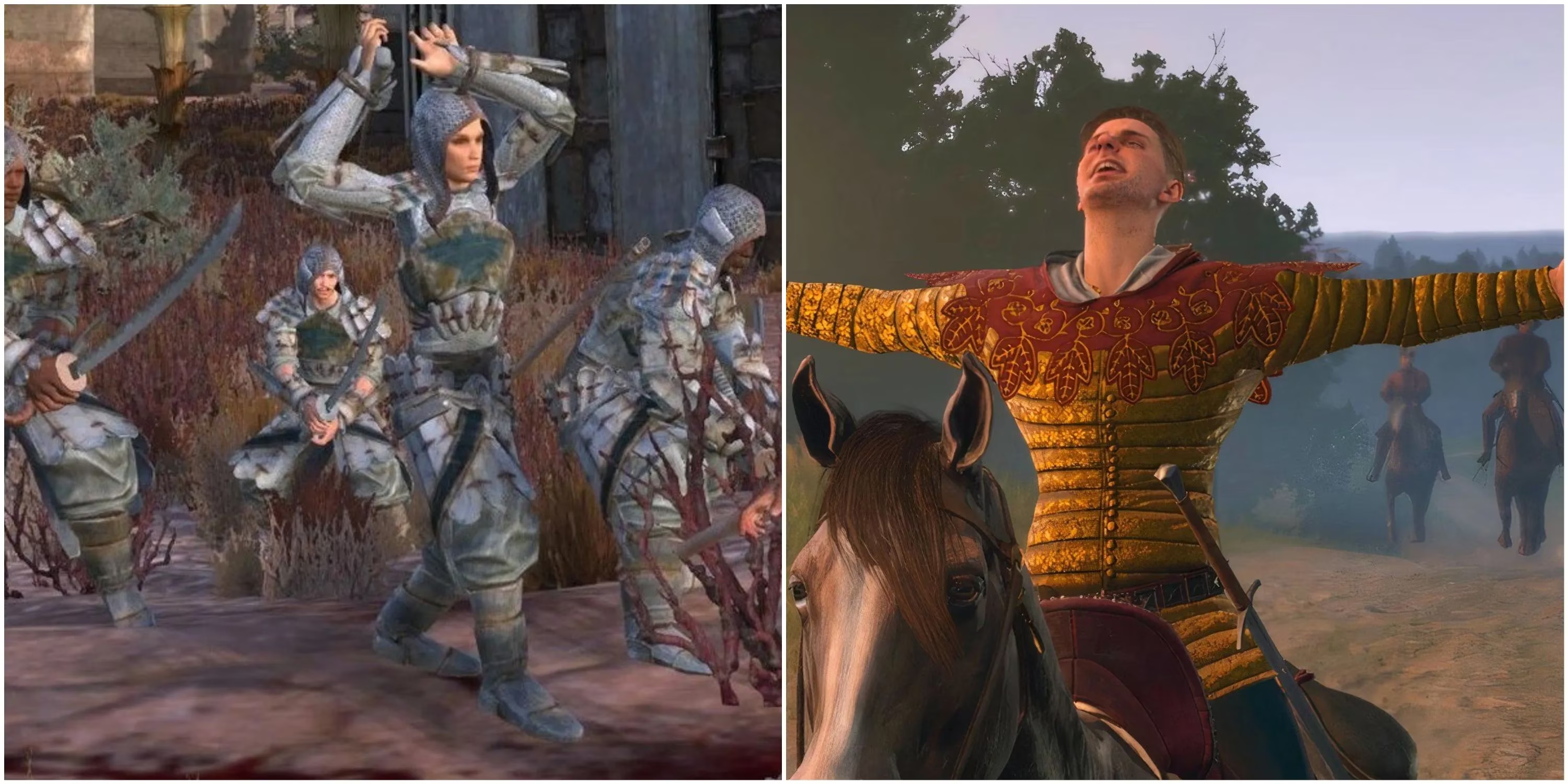
The Matchless Kungfu has carved out a unique space in the hardcore open-world genre with its Wuxia-inspired setting and innovative approach to world exploration. The game's cycle of rebirth means death isn't the end—unless, of course, you're reborn with so many defects that starting fresh seems like the only merciful option.
What truly sets this game apart is its expanding world mechanic. Players begin in a restricted zone, gradually unlocking new areas as their character grows in strength and ability. This isn't just a gating mechanism—it's a thoughtful way of pacing challenges while constantly feeding the player new experiences. The game seems to whisper, "Earn your right to explore," and somehow, that makes every new region feel like a genuine reward rather than just another checkbox on a map.
Surviving the Zone in STALKER: Clear Sky
If you thought other hardcore games were tough, STALKER: Clear Sky might just make you reconsider your gaming prowess entirely. The opening hours of this game are so deliberately obtuse that many players throw in the towel before they've even begun to scratch the surface of what the game offers.
Those with the patience to push through, however, are treated to some of the most intense and satisfying firefights in gaming. The Chernobyl Exclusion Zone isn't just a setting—it's practically a character in its own right, one that's constantly trying to kill you through anomalies, radiation, and hostile factions. Players need to juggle survival stats like they're spinning plates in a hurricane, always one bad decision away from becoming another anonymous corpse in the Zone. Man, this game doesn't just want you to struggle—it wants to watch you squirm!
The Lands Between: Elden Ring's Layered Complexity
Elden Ring continues to stand as a monument to FromSoftware's philosophy that true satisfaction comes from overcoming genuine challenge. For newcomers to the Soulsborne formula, the game presents a mountain of mechanics that can seem insurmountable at first glance.
Players must navigate a complex web of systems: damage types that interact differently with various enemies, weapon scaling that determines long-term viability, character builds that require foresight and planning, and status resistances that can make or break a crucial encounter. The beauty of Elden Ring lies in how it scales its difficulty based on player engagement—those willing to dive deep into its systems can find ways to overcome seemingly impossible challenges, while those who skim the surface will find themselves repeatedly hitting walls of frustration.
The Zombie Apocalypse Simulator: Project Zomboid
In the realm of survival horror, Project Zomboid stands as perhaps the most unforgiving simulation of a zombie apocalypse ever created. The game's central tension comes from a brutal truth: a single zombie bite means infection, and infection means death—no exceptions, no cures.
This single mechanic transforms every encounter into a high-stakes gamble. Players must meticulously develop survival skills, from barricading safe houses to learning how to effectively fight without risking a fatal bite. The early game feels like walking a tightrope without a safety net, but those who persevere will find themselves capable of surviving for weeks or even months in-game, each day a testament to their mastery of the game's systems.
The Depth of Dwarf Fortress's Adventure Mode
Dwarf Fortress has long been known for its mind-boggling complexity as a management sim, but its Adventure Mode transforms it into one of the most detailed and challenging open-world experiences available. This mode allows players to explore the procedurally generated world as a single character, interacting with its history, factions, and inhabitants.
The combat system alone is enough to send casual players running for the hills. Every body part can be targeted, every weapon has unique properties, and every encounter requires tactical consideration. You don't just attack an enemy—you aim for their left upper arm with a slashing motion using your copper short sword, hoping to sever tendons or cause bleeding. It's not just complex for complexity's sake; it creates a depth of simulation that makes every victory feel earned through genuine skill and understanding.
The Roguelike Challenge of Caves of Qud
Caves of Qud combines roguelike elements with an open world in a way that creates a uniquely punishing experience. Death comes swiftly and often in the early game, with players frequently perishing within minutes of beginning their journey.
The key to survival lies in character creation—starting with a build capable of weathering those brutal early encounters is essential. Even veteran players must remain vigilant, as the game's faction system and high-level enemies can end even the most promising run in seconds. The world feels alive and dangerous in a way few games manage, with every step potentially leading to discovery or doom in equal measure.
Medieval Realism in Kingdom Come: Deliverance 2
Kingdom Come: Deliverance 2 has raised the bar for realism in open-world games, building upon its predecessor's foundation with even more complex systems. The combat remains a tough nut to crack, demanding precise timing and an understanding of medieval fighting techniques that few games dare to require.
Beyond combat, the game asks players to maintain Henry's cleanliness and approach situations with caution, as saving options are deliberately limited. This creates a tension that's been lost in many modern games—actions have consequences that can't simply be undone by reloading a save from moments ago. There's something refreshingly honest about a game that tells you, "Think before you act, because you'll have to live with what happens next."
The Rewarding Path of Mastery
These hardcore open-world games share a common philosophy: true satisfaction comes from mastery earned through struggle. In an era where many games prioritize accessibility and immediate gratification, these titles stand as monuments to the joy of overcoming genuine challenge.
For the dedicated few willing to invest the time and patience these games demand, the rewards are incomparable. There's simply nothing quite like the feeling of surviving in a world designed to break you—and eventually thriving in it on your own terms. These aren't just games; they're trials by fire that transform players from helpless beginners into masters of complex systems, one brutal lesson at a time.
And you know what? Sometimes that's exactly what we're looking for.