Why Bloodborne Remains FromSoftware's Masterpiece Over Elden Ring
Elden Ring and Bloodborne captivate gamers with stunning worlds, but Bloodborne's gothic horror and cosmic narrative redefine the genre's artistic heights.
The gaming world erupted when Elden Ring launched in February 2022, shattering records and captivating millions with its sprawling open-world design. The title's meteoric rise to over 20 million players within its first year seemed to cement its status as FromSoftware's crowning achievement. Yet beneath the surface of this commercial triumph lies a controversial truth that hardcore fans have whispered since day one: Elden Ring, for all its grandeur and critical acclaim, doesn't quite reach the artistic heights of its predecessor, the haunting PlayStation exclusive Bloodborne.
The Gothic Horror That Changed Everything
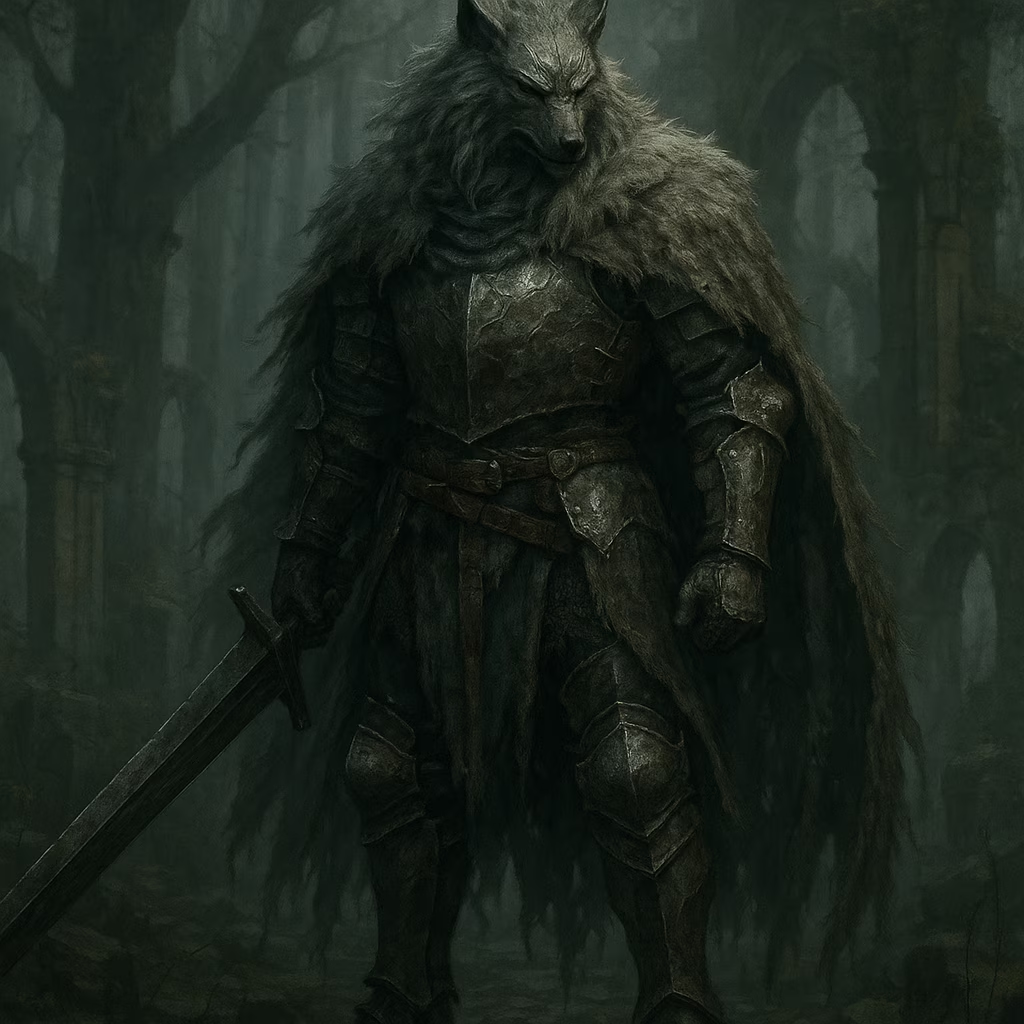
Released in March 2015, Bloodborne represented a radical departure from FromSoftware's established formula. While Elden Ring expanded the studio's signature gameplay across vast landscapes, Bloodborne compressed its genius into the claustrophobic streets of Yharnam, creating an atmosphere so oppressive it practically suffocates players through their screens. This isn't merely an action-adventure game wearing horror's clothing—it's a full-blown survival horror experience that happens to feature soulslike combat mechanics.
Every cobblestone street, every flickering lamp, every grotesque enemy design in Yharnam serves a singular purpose: to terrify. But Bloodborne doesn't rely on cheap jump scares or predictable stalking sequences. Instead, it crafts an environment where everything poses a threat, where danger lurks in every shadow, and where the very architecture seems designed to drive visitors mad. The condensed nature of Yharnam creates an intimacy with dread that Elden Ring's expansive Lands Between simply cannot match.
A Narrative Twist That Redefines Reality
What truly elevates Bloodborne beyond FromSoftware's other masterworks isn't just its horror aesthetic—it's the mind-bending narrative transformation that occurs roughly two-thirds through the campaign. The game begins as a gothic tale of beasts and hunters, a Victorian nightmare of werewolves and plague. Then, without warning, it metamorphoses into something far more sinister: a cosmic horror epic that would make H.P. Lovecraft himself nod in approval.
This narrative pivot isn't a simple map transformation like Elden Ring's Leyndell becoming the Ashen Capital. It's a complete philosophical upheaval that forces players to question everything they thought they understood about the world. Suddenly, the beastly threats that seemed so terrifying become trivial compared to the incomprehensible cosmic entities that truly rule Yharnam. The game doesn't just change—it inverts reality itself.
The Weight of Eldritch Knowledge
Unlike Elden Ring or the Dark Souls series, where defeating bosses provides a sense of accomplishment and progress, Bloodborne's victories feel hollow, even disturbing. Each fallen boss doesn't bring the Hunter closer to salvation—it drags them deeper into an abyss of forbidden knowledge and cosmic horror. The game's story weaves together:
-
Multiple timelines converging in a single nightmare
-
Interdimensional beings manipulating reality from beyond comprehension
-
Ancient rituals that blur the line between hunter and hunted
-
Eldritch truths that fundamentally alter the player's perception
This narrative complexity creates an overwhelming sensation that few games have ever achieved. Players aren't just fighting to survive; they're struggling to maintain their sanity while confronting truths that human minds weren't meant to process.
Combat Philosophy: Facing Fear Head-On
The genius of Bloodborne extends beyond atmosphere and story into its core gameplay mechanics. While Elden Ring offers hundreds of weapons and countless build options, Bloodborne takes a different approach—one that perfectly embodies its thematic essence. The Rally system, which allows players to recover health by immediately counterattacking after taking damage, isn't just a mechanical feature. It's a philosophical statement.
This system forces players to confront their fears directly rather than retreating to safety. Got hit? Don't run away—strike back! It's a brilliant design choice that transforms cowardice into a liability and aggression into survival strategy. No other FromSoftware game, including Elden Ring, has so perfectly aligned its gameplay mechanics with its thematic core.
The Superiority of Trick Weapons
While Elden Ring boasts an impressive arsenal of hundreds of weapons, Bloodborne's more limited selection of trick weapons demonstrates that quality trumps quantity. Each trick weapon in Bloodborne essentially functions as two distinct weapons:
| Weapon Type | Standard Form | Transformed Form | Tactical Advantage |
|---|---|---|---|
| Saw Cleaver | Quick slashes | Extended reach | Versatility in combat |
| Ludwig's Holy Blade | One-handed sword | Two-handed greatsword | Adaptable power scaling |
| Threaded Cane | Whip attacks | Cane strikes | Crowd control options |
| Burial Blade | Curved sword | Scythe | Range manipulation |
This transformation system, combined with firearms and hunter tools, creates gameplay depth that rivals Elden Ring's much larger weapon pool. The difference? Every weapon in Bloodborne feels purposeful, unique, and mechanically distinct. There's no bloat, no redundancy—just pure, refined combat excellence.
The Immersion Factor
Elden Ring suffers from a problem that plagues many open-world games: dilution. The Lands Between, while visually stunning and filled with content, stretches the experience too thin. Players can ride Torrent across vast landscapes, but this freedom comes at the cost of atmospheric intensity. The game's pacing allows for breathing room, which paradoxically weakens its impact.
Bloodborne, conversely, never lets players relax. The interconnected design of Yharnam creates a sense of place that Elden Ring's sprawling map cannot replicate. Every shortcut discovered, every lamp lit, every area explored feels meaningful because the world is so tightly constructed. Players develop an intimate knowledge of Yharnam's layout, understanding how its districts connect and overlap in ways that make geographical sense.
Technical Limitations That Don't Matter
Yes, Bloodborne runs at a capped 30 FPS on PlayStation hardware. Yes, it occasionally suffers from frame pacing issues. Yet these technical limitations fade into insignificance when measured against the game's artistic achievements. The atmosphere, narrative, and gameplay design are so masterfully executed that frame rate becomes a minor footnote rather than a deal-breaker.
Why Elden Ring Falls Short
This isn't to diminish Elden Ring's accomplishments. The game represents a technical marvel, successfully translating FromSoftware's formula into an open-world context while maintaining the studio's signature challenge and design philosophy. It may even be, from a purely technical standpoint, the most mechanically refined soulslike ever created.
However, technical excellence doesn't automatically translate to artistic superiority. Elden Ring lacks the thematic cohesion that makes Bloodborne so special. The Lands Between feel like a greatest hits compilation of FromSoftware's previous work—impressive in scope but lacking a singular, unified vision. The game's length works against it, with the experience feeling padded in ways that Bloodborne's tighter campaign never does.
The Combat Comparison
Elden Ring's combat, while offering more options, doesn't achieve the same visceral satisfaction as Bloodborne's aggressive, rally-focused system. Players can:
-
🗡️ Choose from hundreds of weapons
-
🛡️ Employ various defensive strategies
-
✨ Utilize powerful magic systems
-
🐴 Engage in mounted combat
Yet none of these options create the same adrenaline-pumping intensity as Bloodborne's "attack to survive" philosophy. The trick weapons, despite being fewer in number, offer more meaningful gameplay variety than Elden Ring's bloated arsenal.
The Verdict: Artistic Vision Over Commercial Success
Nearly eight years after its release, Bloodborne remains FromSoftware's most complete artistic statement. It's a game where every element—from environmental design to combat mechanics to narrative structure—works in perfect harmony to create a singular, unforgettable experience. The game doesn't just tell a story about cosmic horror; it makes players feel that horror through every aspect of its design.
Elden Ring may have sold more copies, attracted more players, and generated more mainstream buzz. But commercial success and critical acclaim don't automatically equal artistic superiority. Bloodborne achieved something rarer and more valuable: it created a perfectly realized vision that has yet to be surpassed, even by its own creators.
The Future: Can Elden Ring's DLC Change the Equation?
The recently announced DLC for Elden Ring presents an intriguing possibility. Could additional content provide the thematic focus and narrative cohesion that the base game sometimes lacks? Might FromSoftware use this expansion to deliver a more concentrated, Bloodborne-esque experience within Elden Ring's framework?
Only time will tell. But as of 2026, with both games now part of gaming history, the verdict remains clear: Bloodborne stands as FromSoftware's greatest achievement—a lightning-in-a-bottle moment where atmosphere, gameplay, and narrative aligned to create something truly transcendent. Elden Ring may be the more successful game, but Bloodborne is the better one. 🌙
The Hunter's nightmare continues to haunt players' memories precisely because it achieved what few games ever do: it created an experience so perfectly crafted, so thematically unified, and so artistically bold that it redefined what the studio—and the genre—could accomplish. That's a legacy no sales figures can diminish.